Heartbreak in Islam – How to Heal a Broken Heart the Islamic Way
In this reflection

Heartbreak is one of the most painful human experiences. Whether it comes from the loss of a relationship, a deep betrayal, an unfulfilled hope, or the passing of a loved one — the ache in the chest can feel unbearable. But as Muslims, we are never alone in our pain. Islam offers a profound, gentle roadmap to heal a broken heart — through Sabr (patience), Dua (supplication), Dhikr (remembrance), and unshakeable Tawakkul (trust in Allah).
In this post, we explore what Islam truly teaches about heartbreak, the Quranic ayaat that bring comfort, duas the Prophet ﷺ himself taught us, and practical daily steps to find Sukoon — true inner peace — again.
💔 Why Does Heartbreak Hurt So Much?
Feeling heartbroken is not a sign of weakness — it is a sign of being fully human. Even our beloved Prophet Muhammad ﷺ experienced profound grief. The year he lost his wife Khadijah (RA) and his uncle Abu Talib is known in Islamic history as Aam al-Huzn — the Year of Grief. Allah did not remove the Prophet's grief instantly — but He revealed Surah Ad-Duha to reassure him: "Your Lord has not forsaken you."
Allah (SWT) created us with hearts capable of deep love, and so also capable of deep pain. But He did not leave us without guidance or comfort.
📖 What Does Islam Say About a Broken Heart?
Islam does not tell us to suppress our emotions or pretend we are fine. The Quran acknowledges grief, loss, and emotional pain repeatedly — and always pairs hardship with a promise of ease. Allah's word is clear:
This verse is so important that Allah repeats it twice in the same Surah — using the definite form al-usr (the hardship) paired with the indefinite yusr (an ease) — meaning one hardship, but many eases. Your pain is real. But more ease than you can imagine is already written for you.
🤲 6 Islamic Ways to Heal a Broken Heart
1. Turn to Salah — Your Direct Line to Allah
When the heart is shattered, Salah becomes your anchor. Those five daily prayers are not just rituals — they are private conversations with the Creator who already knows every corner of your pain. The closest you are to Allah is in Sujood. Pour your heart out there. Cry. Ask. He hears every word, even the ones you cannot form.
2. Make Sincere Dua — Ask, and He Always Listens
There is no more powerful act than calling upon Allah in your weakest moments. The Prophet ﷺ taught us a specific dua for grief and anxiety:
Also recite: "Hasbunallahu wa ni'mal wakeel" — Allah is sufficient for us, and He is the best Disposer of affairs. This was the dua of Ibrahim (AS) in the fire and Muhammad ﷺ before battle. Say it when the grief feels like a fire you cannot escape.
3. Practice Sabr — Patience is a Superpower
Sabr does not mean being silent or suppressing your feelings. It means choosing not to despair — choosing to trust Allah's wisdom even when the heart aches and the mind cannot understand why. Allah does not just command Sabr — He promises to be with those who practice it:
4. Recite Quran — Let the Words Heal From Inside
Make Surah Ad-Duha and Surah Al-Inshirah your daily companions. These two surahs were revealed specifically during a period when the Prophet ﷺ was experiencing deep sadness. They are Allah's direct, personal words of comfort to a grieving heart. Read them with meaning — not just as recitation, but as a conversation.
5. Do Dhikr — Remember Allah, Find True Rest
Repeat SubhanAllah, Alhamdulillah, Allahu Akbar — especially in the quiet moments when grief feels loudest. Dhikr is not just spiritual; research in positive psychology supports that gratitude and mindful repetition genuinely rewire anxious thought patterns. In Islam, we knew this 1,400 years ago.
6. Seek Support — It Is Sunnah to Lean on Others
The Prophet ﷺ never faced his trials alone. He had Khadijah (RA), Abu Bakr (RA), and his companions. Seeking help from a trusted family member, a wise friend, or a qualified Islamic counselor is not weakness — it is Sunnah. You do not have to heal in isolation.
- Pray all 5 Salah on time — pour your heart out in every Sujood
- Recite Surah Ad-Duha + Surah Al-Inshirah every morning
- Say "Hasbunallahu wa ni'mal wakeel" at least 100× daily
- Do morning & evening Adhkar — 10 minutes, life-changing
- Limit social media — it amplifies comparison and loneliness
- Journal your feelings + write 3 things you are grateful for daily
- Speak to a trusted person or Islamic counselor — do not isolate
🌙 Trusting Allah's Plan — Even When It Hurts
Sometimes the thing we wanted most — a person, a relationship, a future we had imagined — was simply not written for us. And that is not cruelty. That is mercy dressed in pain.
Allah did not remove that person or situation from your life to punish you. He removed it to protect you — to redirect you toward something that truly belongs to you. The heart that breaks over the wrong thing is being gently cleared for the right blessing. Trust the process. Trust the Plan.
💛 Your broken heart is not the end of your story — it is the beginning of a deeper, more honest relationship with Allah.
He who created your heart also knows exactly how to mend it. Return to Him with all your pieces. He does not need you to be whole to love you.
"And He found you lost and guided you." — Surah Ad-Duha, 93:7
Continue reflecting
Title: “Healing Takes Time – And That’s Okay” "شفا وقت مانگتی ہے – اور یہ بالکل ٹھیک ہے
Sometimes healing doesn’t look like joy. It looks like crying in sujood. Like saying “Alhamdulillah” with a trembling voice. Like getting up and trying again… even…

Tawakkul: Trusting Allah When Nothing Makes Sense
💡 Content Integrity: All Quranic ayaat and ahadith in this article are sourced from authenticated collections (Sahih al-Bukhari, Sahih Muslim, Sunan at-Tirmidhi).…
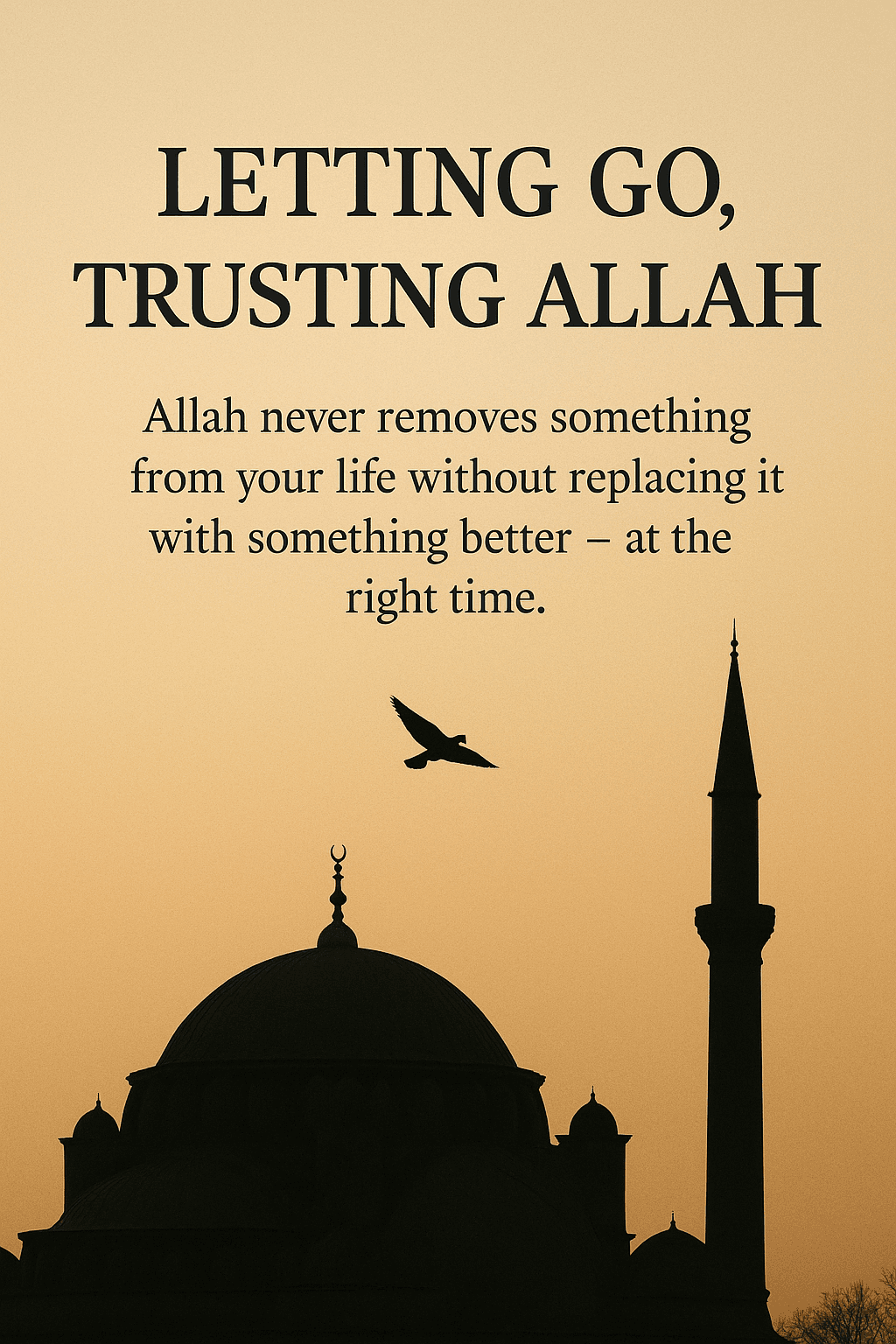
Letting Go, Trusting Allah
Sometimes, holding on hurts more than letting go. And in those quiet moments when your heart is tired, remember this: Allah never removes something from your life…