When Hearts Break: How to Reconnect with Allah > “Sometimes people break your heart to make space for Allah to enter.
In this reflection

When Hearts Break: How to Reconnect with Allah
Human experience is bound by an unspoken truth: at some point, we all face psychological fracturing. Relational rejection, unexpected betrayal, or the cold reality of shifting human loyalty can leave an individual in a state of deep emotional despair. For anyone managing a demanding personal or professional reality, a broken heart is not just an emotional phase—it is a heavy weight that disrupts your focus, saps your physical strength, and clouds your inner clarity. The pain of feeling discarded or unappreciated by those you trusted implicitly can destabilize your entire sense of security.
Yet, within the spiritual framework of Islamic psychology, emotional fracturing holds a revolutionary secondary purpose. When human attachments break, they reveal a profound truth: your heart was never engineered to find permanent, unyielding security in created things. The cracks left behind by human rejection are not meant to destroy you; they are systematically designed by Al-Hakim (The All-Wise) to shatter the illusions around you, making immediate, direct space for the Divine presence to enter.
The Psychology of Human Rejection and Spiritual Realignment
Why does human betrayal cut so deeply into the human psyche? From a clinical perspective, human beings are neurologically wired to seek safety in validation, community, and relational attachments. When these external pillars collapse unexpectedly, the ego experiences a severe shock. We often internalize this rejection as a personal deficit, asking ourselves why we weren't enough to secure the loyalty or care we so desperately craved.
However, modern behavioral science notes that when an individual experiences deep emotional trauma, their cognitive processing naturally slows down, pulling away from external world distractions. This forced isolation is where the spiritual transformation begins. In a traditional setting, we look for immediate distractions to numb this ache. But Islam teaches us to face this empty space with intentionality. Rejection by people is very often a hidden redirect from Allah, protecting your soul from a source of comfort that would have ultimately compromised your spiritual sanity.
The Quranic Perspective: The Broken Heart as a Sacred Vessel
In a world that metrics your personal value by your social status or your ability to maintain effortless, picture-perfect relationships, Islam presents a beautiful alternative: Allah is intimately present with those who are broken. The Divine Creator does not turn away from your heavy sighs, your unvoiced tears, or the silent ache in your chest. He addresses our built-in human vulnerabilities directly within the sacred text:
When human hands let go of you, the Divine protection wraps around you with absolute certainty. The Arabic word Ma'iyyah (Divine togetherness) signifies that Allah's specific support, comfort, and mercy descend directly upon those stripped of worldly insulation. A broken heart is highly receptive; it is empty of worldly expectations, making it the perfect vessel to receive the absolute fullness of Divine Light.
Neuroimaging research confirms that the brain processes intense emotional heartbreak and relational rejection through the exact same neural pathways as physical pain—specifically activating the anterior cingulate cortex. When individuals transition their coping mechanisms toward spiritual mindfulness and structured prayer (Tawakkul), functional MRI scans show an immediate down-regulation of stress responses, fostering emotional recovery, cognitive parsing, and psychological resilience.
Rebuilding the Broken Vessel: The Path of Al-Jabbar
To heal an aching heart, we must shift our focus away from the source of our pain and place it firmly upon the one who heals it. One of the most beautiful names of Allah is Al-Jabbar—The Restorer, The Mender of Broken Hearts. The word originates from the root used to describe the careful setting of a broken bone so it can heal stronger than it was before.
When you sit alone on your prayer mat, you do not need to hide your wounds or articulate your pain in flawless words. Turning toward Allah with absolute transparency—admitting your weakness, your confusion, and your hurt—is the first practical step of Tawakkul (complete reliance). By handing your broken pieces over to Al-Jabbar, you allow your heart to discover its true Sukoon, rebuilding your energetic reserve for the days ahead.
Signals that Your Heart is Making Space for Allah:
- A Decreased Desire for Worldly Validation: You no longer look to people to define your core worth.
- Increased Focus during Prayer: Your brokenness drives you to a state of raw, honest conversation with your Creator.
- Softness toward Others: Experiencing pain deepens your empathy for the struggles of those around you.
- A Deep Sense of Detachment (Zuhd): Realizing that permanent, perfect peace belongs only to Allah.
Practical Steps: Reconnecting When Your Spirit Feels Fractured
How do we translate this spiritual paradigm into a practical routine when the pain feels overwhelmingly heavy? It requires establishing firm, intentional boundaries around your mental space:
Pour it Out in Tahajjud: Utilize the final third of the night when the world is completely silent. Cry out your pain, your frustrations, and your unspoken grief before Allah. It is a space where your tears are completely safe, transformed into an act of deep obedience and spiritual alignment.
Immerse Yourself in the Quran: Do not let your mind dwell on agonizing loops of what went wrong. Read the verses of healing, allowing the rhythmic, divine words to tone your vagus nerve, lower your heart rate, and remind your soul that its primary relationship is with its Maker.
To the soul reading this in a quiet space, bearing a heavy ache that no one else can see: give yourself permission to heal tonight. The human expectations can be gently released. People may fail you, disappoint you, or walk away, but Al-Wadud (The Loving) is always waiting for you to return. View this moment not as your destruction, but as a calculated clearing of your inner space. Settle into His remembrance, allow your frame its divine right, and let your heart discover its true Sukoon.
Frequently Asked Questions (FAQ)
Continue reflecting
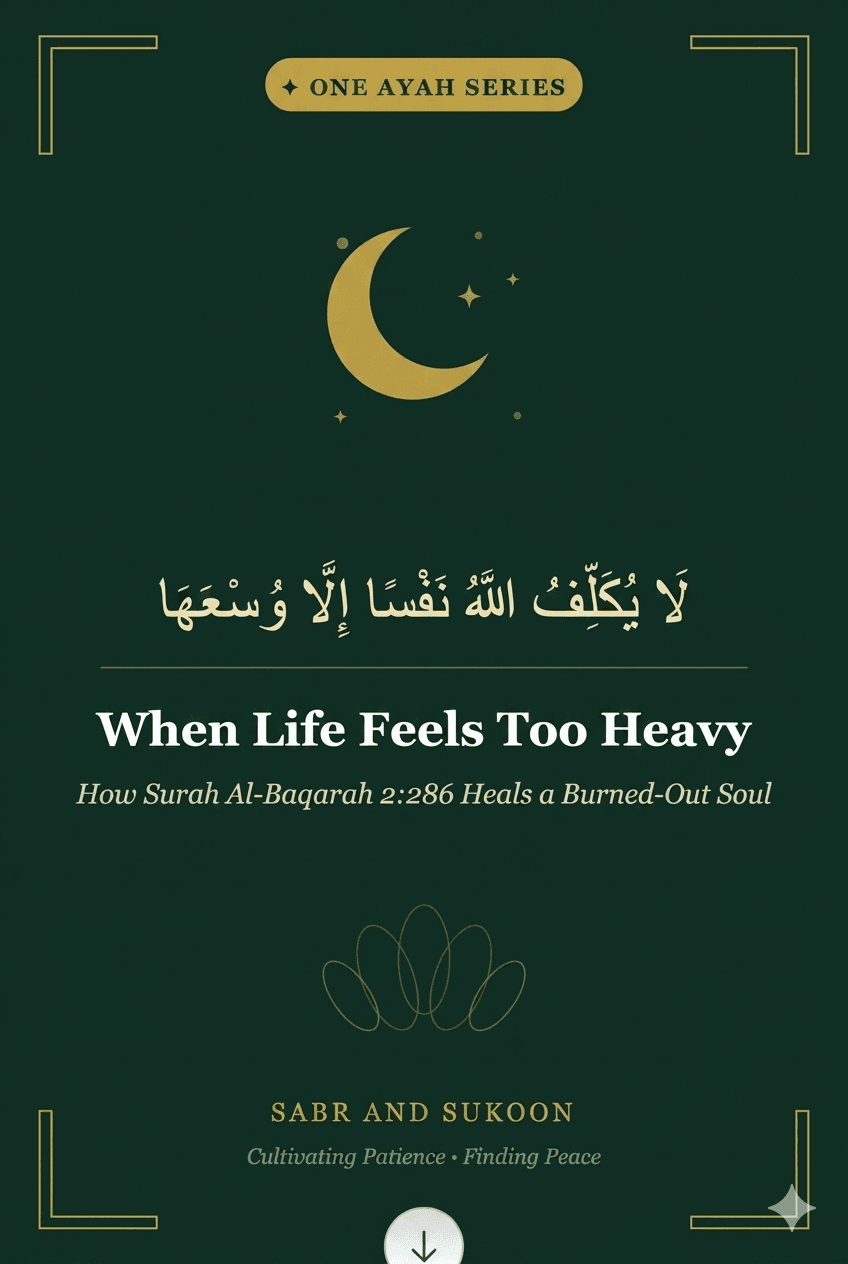
How Does Surah Al-Baqarah 2:286 Help With Burnout and Overwhelm in Islam?
🏠 Al-Baqarah 2:286 — Burnout & the Soul When Life Feels Too Heavy: How Surah Al-Baqarah 2:286 Heals a Burned-Out Soul By Nazia Firdous · Sabr and Sukoon · Islamic…
Why the Prophet ﷺ Fasted on Mondays and Thursdays — And Why It Matters for You
Your deeds are being presented to Allah twice every week. What do you want them to look like? Have you ever reached a Monday feeling heavy — spiritually scattered,…

Surah Ad-Duha: The Ayah That Heals a Hopeless Heart
One Ayah Series Surah Ad-Duha The Ayah Allah Revealed When the Prophet ﷺ Felt Abandoned مَا وَدَّعَكَ رَبُّكَ وَمَا قَلَىٰ By Nazia Firdous · Sabr and Sukoon · June…